

Tax compliance plays a crucial role in businesses or any source of earning in India. It stands for a company or an individual’s compliance with applicable tax laws. In other words, it is about meeting the requirements of the Tax Collection Act of India, filing the necessary documents and forms, and paying taxes on time.
It becomes essential that every taxpayer must have a fundamental knowledge and understanding of tax compliance to remain on the safe side.
In this blog, we will discuss what tax compliance is, its different types, requirements, and penalties. Moreover, we will also learn how individuals and businesses can maintain compliance.
What Is Tax Compliance?
Tax compliance means tax governance in relation to all matters which are covered under the Income-tax Act, 1961 including computation and payment of taxes, filing tax returns, and maintaining records.
Thus, in other words, tax compliance boils down to a set of procedures to be followed by any individual or entity in relation to their income.
For instance, if a taxpayer is liable to collect and pay Goods and Services Tax (GST), they would be required to file GST Returns and pay the amount of tax due from time to time to the government. On the other hand, a taxpayer eligible to claim a refund of tax paid needs to file an income-tax return for the same.

The various kinds of activities involved in tax compliance include the following:
- Calculation of the amount of tax due.
- Filing of income-tax returns and GST returns (if applicable).
- Payment of TDS (Tax Deducted at Source) within the due dates.
- Settlement of taxes on time.
- Maintenance of bills, invoices, and records.
- Compliance with applicable laws and response to notices issued by the tax authorities.
Tax compliance helps businesses and individuals to perform their duties related to the tax system and deal with matters in a systematic and appropriate manner.
Why Is Tax Compliance Important for Individuals and Businesses?
The compliance of tax is beneficial in several ways, including compliance with tax laws, avoidance of late and other penalties, and recording of financial activities.
Below are a number of benefits of ensuring tax compliance in a country.
1. Helps Avoid Penalties and Interest
Late submission of tax filings and non-compliance with tax laws and guidelines incurs late fees, interest charges, penalties, or any other applicable charges to the taxpayer.
It is necessary to file tax and pay taxes on time to avoid any late or non-compliance fees and charges.
2. Builds Business Credibility
A company that keeps its accounts and tax records in order shows that it takes its financial and tax obligations seriously.
This may be beneficial when dealing with banks, creditors, suppliers, and business partners.
3. Keeps Financial Records Organised
Tax compliance requires a company to keep its sales, purchases, expense, income, and tax records in order. These documents are used to prepare the financial statements, analyze the financial position of the company, and plan its future development.
4. Reduces the Risk of Tax Notices
The errors in the tax reports, incomplete documentation, and late payments of taxes may result in a company’s audit by the tax department. It is essential to fulfill all tax obligations to avoid additional expenses, liabilities, and stresses.
5. Supports Business Growth
When a business complies with tax regulations and keeps accurate financial records, it is possible to plan personal or corporate finances more efficiently and control spending correctly.
What Are the Different Types of Tax Compliance in India?
There are several types of tax compliance in India. Taxpayers’ obligations depend on their income, activities, turnover, organizational structure, and other factors.
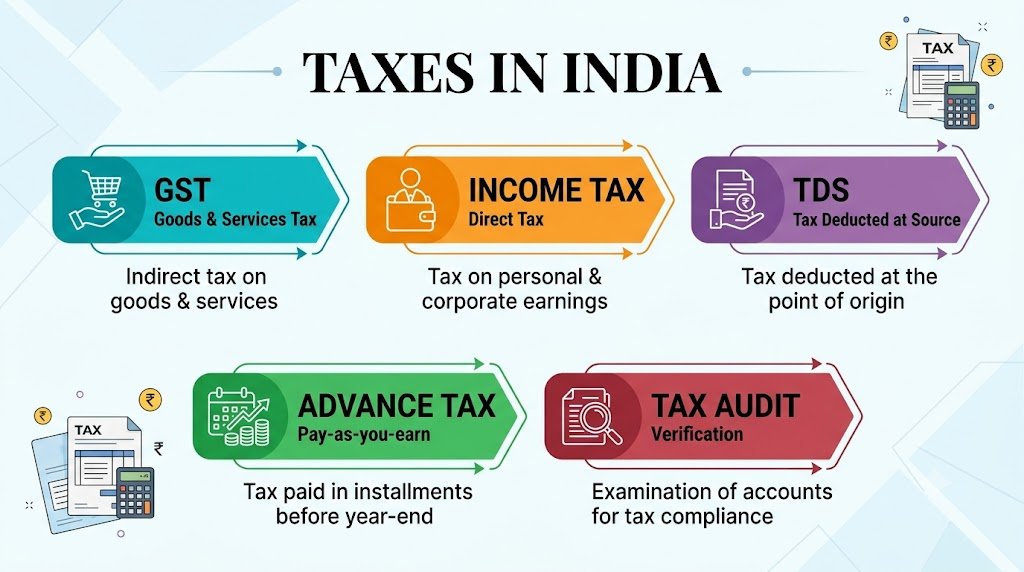
1. GST Tax Compliance: Registration, Returns and Payments
Goods and Services Tax (GST) is a consumption-based indirect tax applied to a range of goods and services in India.
Eligible businesses must register, calculate, and remit GST, submit GST returns, and invoice supplies in accordance with GST regulations.
Key GST compliances for businesses include the following:
- Applying for a GST number if a person’s turnover meets the prescribed limit.
- Issuing invoices to buyers in accordance with GST norms.
- Maintaining stock records and purchase records.
- Filing the necessary GST returns, including GSTR-1 and GSTR-3B.
- Settling the GST liability in the prescribed time.
- Claiming input tax credit and reconciling the same.
For instance, a company that sells goods to buyers on a taxable supply chain must submit a tax invoice and levy GST on the sale. It must report the tax and pay it to the tax authority as prescribed.
Every business entity does not have the same GST requirements. Businesses must assess their requirements concerning turnover, composition scheme, and returns in accordance with GST laws.
2. Income Tax Compliance: ITR Filing and Tax Payments
Income tax is a tax on income earned by individuals and other taxpayers.
Income tax compliance includes accurate disclosure of income, calculation of tax liability, payment of tax due, and filing of Income Tax Return (ITR) in case of applicability.
Some important activities to do while dealing with income tax are:
- Maintaining records of income from salary, business, profession, rent, etc.
- Ascertainment of eligible deductions and exemptions.
- Arrival at taxable income and amount of tax payable.
- Payment of advance tax if any.
- Filing of ITR in Form applicable and in time.
- Verification of return and response to notices issued by tax authorities, if any.
Example: A freelancer earns income by providing digital marketing services on a freelance basis. Such a person must ensure that he/she maintains records of income and expenses, calculates his/her tax liability based on applicable provisions, and complies with filing and payment requirements.
The requirement to file ITR depends on applicable provisions and the position of the taxpayer.
3. TDS and TCS Compliance: Payments, Returns and Certificates
TDS stands for Tax Deducted at Source. It is tax that is deducted from certain payments before the remaining amount is issued to the payee.
TCS stands for Tax Collected at Source. This is tax that, under applicable provisions, either the seller or some other specified person collects from the buyer or other specified person.
Businesses are generally obligated to deduct or collect the relevant tax, deposit the tax with the government, submit statements and issue the relevant certificates.
Key activities in relation to TDS and TCS compliance include:
- Determining which transactions fall under TDS or TCS provisions.
- Selecting the appropriate rate and threshold.
- Depositing the relevant tax with the government by the relevant deadline.
- Filing the relevant TDS or TCS statement.
- Issuing certificates where required.
- Correcting any errors in filed statements, where required.
For example: A company pays professional fees to a consultant. If the payment falls under a TDS provision, the company may have to deduct tax from the payment and deposit with the government.
The applicable rate and other requirements then depend on the type of payment and the relevant law.
4. Advance Tax Compliance: Instalments and Payments
Advance tax is a type of income tax that is paid by the taxpayer during the financial year instead of paying the whole amount at the year-end.
It is usually based on an estimate of the tax due by the taxpayer under the applicable income-tax law for the financial year, subject to certain exceptions.
Advance tax is typically applicable where the taxpayer is a businessman, professional, freelancer, or someone who earns income that does not have enough tax withheld at the time of payment.
Steps To Pay Advance Tax
- The taxpayer must first calculate their income for the financial year.
- They must then calculate their tax liability.
- They must also consider any eligible tax credits and tax deducted at source (TDS).
- The taxpayer should check if advance tax is applicable to them.
- They must pay the calculated amount in advance tax instalments by the due dates.
By paying the advance tax correctly, taxpayers can avoid the interest on short or late payments that would otherwise be due to them.
5. Tax Audit Compliance: When Is an Audit Required?
A tax audit is a process of reviewing the accounts and related procedures of a company to ascertain if it meets the law requirements.
Some companies and professionals are required to have their accounts audited under the income tax law at a given period.
The requirements for tax audit include:
- Holding of books of account.
- Preparation of statements of accounts.
- Verification of income, expenses, and documents.
- Engaging a competent Chartered Accountant to perform the audit.
- Completion of the audit and presentation of the required report within the specified time.
A tax audit is not mandatory for every organization. Individuals and organizations should consult these requirements and apply where necessary.
Tax Compliance Requirements for Businesses, Startups and MSMEs
Different businesses have different tax compliance needs. While a small business may have lesser reporting needs compared to a big corporation, a startup may need to file additional taxes based on the type of business structure it has.
Below is a quick glance at taxpayers and their compliance needs.
Type of taxpayer
Tax compliance needs
Salaried individual
Reporting of income, verifying tax deducted and filing of ITR in case of eligibility
Freelancer/Consultant
Maintenance of income and expense books, checking of advance tax and filing of applicable returns
Small business/MSME
Compliance with GST (if any), income tax, TDS/TCS (if any) and recordkeeping
Startup
Tax registration and filing requirements depending on the nature of the business model and structure
Private limited company
Company tax, applicable GST and TDS and separate corporate law filings
Partnership firm/LLP
Applicable income tax return filings, payment of taxes and other statutory filings.
Important Things Businesses Should Remember
- Know your tax liabilities – Understand what tax laws apply to your business.
- Maintain proper accounts – It is critical to maintain all important business expense and income records.
- Remember due dates – Create a reminder or a calendar of when you need to file your taxes.
- Check records – Always verify your invoices, cheques and tax returns.
- Seek help when needed – Consult a tax expert if there are uncertainties.
Remember that tax and statutory compliance are not one and the same. Statutory compliance is a wider term that covers tax laws as well as other company law and labour law requirements.
Tax Compliance Checklist for Indian Businesses
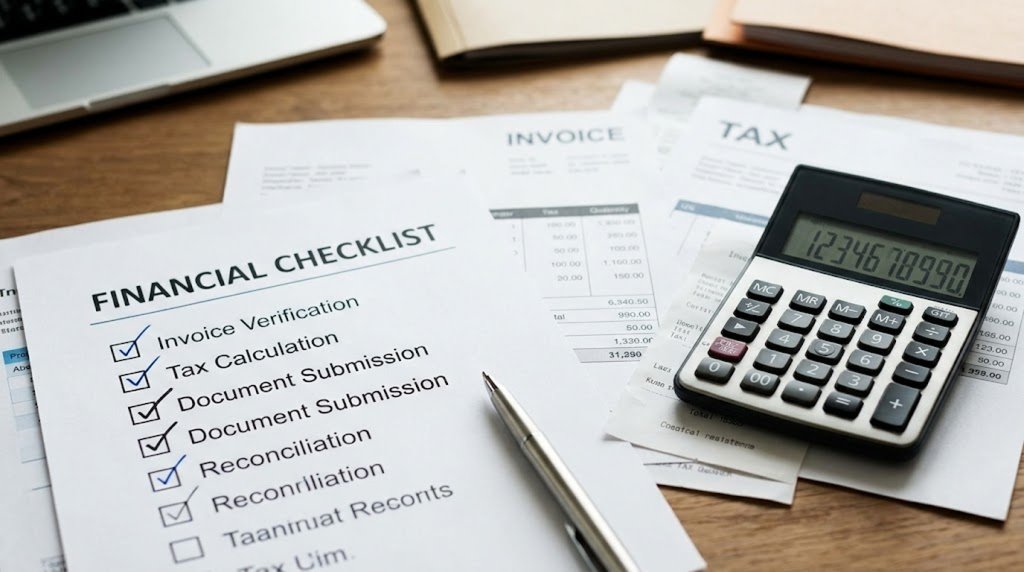
A tax compliance checklist is a helpful guide that reminds business owners of their important responsibilities. Here is a checklist that you can use to review your businesses’ tax activities.
Compliance activity
What to do
Tax registration
Check if GST or another registration is necessary
Sales and purchase records
Make sure invoices and supporting documents are available
GST returns
File the applicable returns on time
GST payments
Pay the tax due within the applicable deadline
Income tax
Calculate taxable income and file the required return
TDS and TCS
Deduct or collect tax and deposit it, and file statements where applicable
Advance tax
Check if advance tax applies and pay instalments when required
Tax audit
Check if your business meets the applicable audit conditions
Financial records
Keep books of account, bank statements, and supporting documents organised
Tax notices
Review notices carefully and respond within the stated time
Tip: Review the checklist frequently rather than waiting until the end of the financial year. Some compliance activities are monthly and quarterly, while others are annual or event-based.
Tax Compliance Due Dates: Monthly, Quarterly and Annual Tasks
Tax compliance deadlines are dependent upon the nature of the return, class of taxpayer, financial year, and applicable law.
The below table is a working guide for taxpayers to plan their tax compliances. This table does not contain a static list of statutory deadlines.

Frequency
Common compliances
What to do
Monthly
Applicable GST returns and payments, TDS deposits
Identify the relevant obligation and applicable deadlines
Quarterly
Applicable quarterly GST or TDS statements and advance tax instalments
Refer to the applicable filing/payment calendar
Annually
Income tax returns, tax audit (where applicable), and annual tax review
Ascertain the applicable due date based on the taxpayer category
Event-based
New tax registration, amendment to registration or other prescribed compliances
Ensure that the due action is taken in time
How to Keep Track of Tax Compliance Deadlines
- Prepare a calendar for the financial year
- Identify all the returns and payments applicable to your business
- Set reminders before the due dates
- Ensure that the relevant documentation is in place before the due date
- Stay updated with changes/applications on government websites
- Retain copies of filed returns and payment receipts
For the latest developments, refer to the Income Tax Department and GST Portal
Never rely on an older blog or the previous year’s compliance calendar as there are often changes to tax deadlines.
What Are the Penalties for Non-Compliance with Tax Laws?
Tax non-compliance is a scenario where a taxpayer fails to comply with any tax law relating to them.
Depending upon the type of default, law violated, quantum of tax involved, and other factors, the consequence of non-compliance can vary.
Type of non-compliance
Consequences
Late income tax return
Late filing fee or other consequences as applicable
Delayed tax payment
Interest and other applicable charges
Delayed GST return
Applicable late fees and interest
Failure to deposit TDS
Interest and other consequences as applicable under the relevant law
Incorrect tax reporting
Additional tax, interest, penalties or other inquiry as applicable based on the scenario
Failure to meet audit requirements
Applicable penalties or other consequences as per the law
How Can You Avoid Tax Penalties?
By filing returns on time and making tax payments as and when due, maintaining proper records, and cross-verifying the calculations, taxpayers can avoid such scenarios.
In case of any default, detection by the authorities, or receipt of intimation under the Income-tax Act, one must analyze the situation and seek professional help if required. The next step to be taken will depend on the scenario.
Although there are a set-off rules for such defaults, not every situation leads to the same consequences. Some laws provide for relief, adjustment, or correction, among others.
Common Tax Compliance Mistakes and How to Avoid Them
Many taxpayers get into trouble with authorities due to simple mistakes or because of incomplete records.
Below are some of the most common problems and solutions.
1. Missing Filing Deadlines
Problem: Taxpayers may be charged additional fees if they fail to meet a deadline on filing a return or making a payment.
Solution: Set up a calendar of compliance deadlines and remind yourself well in advance of any due dates
2. Entering Incorrect Information
Problem- Incorrect income, tax details or invoice information may lead to mismatches
Solution- Carefully check the information before finalizing.
3. Ignoring TDS Requirements
Problem- Some businesses tend to forget to assess if tax has to be deducted from a particular payment
Solution- Always review the relevant TDS provisions while making a payment.
4. Maintaining Incomplete Records
Problem- Invoices or expense receipt may get misplaced which can prove to be fatal while preparing tax returns.
Solution- Maintain electronic copies of invoices, bank statements, receipts and any other relevant documents
5. Relying on Outdated Tax Information
Problem: Using old or incorrect tax information could result in errors
Solution: Double-check tax information using official government resources or a tax professional.
6. Assuming Every Business Has the Same Requirements
Problem: Different business types have different tax requirements.
Solution: Learn your business’s tax and legal requirements instead of relying on another company’s guidelines.
How to Maintain Tax Compliance: Step-by-Step Process
Following a few steps in order can make it much easier to stay compliant with tax laws.
Step 1: Identify Applicable Tax Rules
See if you need to register for GST, file income tax returns, pay TDS, pay advance tax or get your accounts audited.
Step 2: Organise Financial Documents
Make sure to keep invoices, bank statements, expense claims, payroll cheques and other documents in an organised manner.
Step 3: Record Business Transactions
Record income, purchases, expenses and tax-related transactions accurately and update your books regularly.
Step 4: Calculate Taxes Correctly
You need to calculate the tax due correctly based on your financial records. Make sure to understand the deductions, credits and tax that your company has already paid, and which are allowed by the regulations.
Step 5: File Returns and Pay Taxes
Prepare and file the necessary tax return forms, and pay the amounts due in accordance with the relevant deadlines.
Step 6: Verify and Store Records
Check filing acknowledgments against payments made. Retain copies of filed information and supporting documentation for your records.
Step 7: Review Compliance Regularly
Your compliance records should be reviewed on a monthly or quarterly basis depending upon your particular compliance needs. If you find an error take the proper corrective action based upon the type of error.
The above procedure should allow any organization to set up a good tax compliance program.
Documents and Records Required for Tax Compliance
The documents that are required for filing a tax return depend upon the income, business activity and applicable taxes.
Some of the commonly required documents are as follows:
- PAN and other relevant identification or registration details.
- GST registration details, if applicable.
- Sales and purchase invoices.
- Bank statements and expenses.
- Receipts of payment.
- Books of account and financial statements.
- Payroll records, if applicable.
- TDS certificates and statements.
- Previous tax returns and payment acknowledgments.
- Tax audit report, if applicable.
- Documents supporting deductions, exemptions and tax credits.
Maintaining these documents in an organized manner helps individuals and businesses in filing accurate returns, answering questions from tax authorities and in reviewing the financial position and performance of the business.
These documents should be kept for the period required by the relevant law and also preserved in a secure place.
How Can a Tax Consultant Help With Tax Compliance?
A Tax consultant can guide individuals and businesses through the complexities of tax laws and ensure that they remain compliant.

Based on their credentials and area of expertise, a tax consultant can help you with :
- GST registration and return filing
- Income tax return filing
- TDS compliance and statement filing
- Advance tax calculation
- Tax audit
- Scrutiny of financial records
- Spotting errors and areas of non-compliance
- Receiving notices from tax authorities and advising on the course of action
For instance, if you are an MSME, you may have multifaceted compliances to deal with apart from managing your business. This is where a tax expert can walk you through the process and ensure that you file all tax returns on time without any mistakes.
Make sure you pick a professional who has the right expertise to address your needs.
Conclusion
Tax compliance is a critical aspect of one’s finances and business in India. It entails your responsibility to follow tax laws, regulations, and requirements, keep track of your financial records and documents, file tax returns, pay taxes, and fulfill other obligations.
You may rely on a compliance checklist, deadlines, and records of your financial documents to stay ahead of your tax obligations.
If you have questions about GST, income tax, TDS, or tax audit, consulting a tax expert will help you get the answers and guidance you need.
Don’t know where to start? Explore Taxferro’s tax and financial services to see what options are available to you.
